
Is a Rental Property in North Jersey Worth It? How to Run the Numbers Before You Buy
Buying a rental property can sound like a straightforward path to building wealth. Purchase a home, find a tenant, collect rent, and let the property appreciate over time.
But there's a big difference between owning a property that generates rental income and owning one that actually makes financial sense.
In Northern New Jersey, where purchase prices and property taxes can be substantial, the math deserves careful attention before you make an offer.
So, how do you know whether a rental property is a worthwhile investment?
Start by looking beyond the rent.
1. Start With the Property's Total Cost
Before estimating potential returns, calculate the actual cost of acquiring the property.
Your initial investment may include:
The down payment.
Closing costs and lender fees.
Inspections and other due diligence.
Immediate repairs or renovations.
Initial reserves for vacancies and unexpected expenses.
If the property needs a new roof, an updated heating system, or other major work, those costs can significantly affect the investment.
A property that appears inexpensive may require more cash to make it rental-ready. Conversely, a higher-priced property in better condition may have fewer immediate expenses.
The purchase price is only the starting point.
Considering an Investment Property in Northern New Jersey?
The Beckwith Team can help you evaluate local property options, understand neighborhood differences, and identify questions worth investigating before you move forward.
Thinking about buying a property in North Jersey? Let's talk about what you're looking for.
2. Calculate the Real Monthly Rental Income
Next, estimate the rent you can reasonably expect to collect.
Research comparable rentals in the same area, paying attention to property type, bedrooms, condition, amenities, parking, and location. An advertised rental price doesn't prove a tenant will pay that amount, or that the property will remain occupied continuously.
Then account for vacancy.
Even a well-managed rental can have gaps between tenants, delayed payments, or periods when repairs prevent you from renting the property.
For a simple first-pass estimate, you might set aside 5% of expected annual rent for vacancy and collection losses. That is an illustrative assumption, not a universal benchmark; your actual allowance should reflect the property's circumstances and local rental conditions.
3. Don't Forget the Expenses
This is where many first-time investors underestimate ownership costs.
Your monthly expenses may include:
Mortgage principal and interest: If you're financing the property, this is often one of your largest expenses.
Property taxes: Review the actual tax bill and consider how future assessments or tax changes could affect the investment.
Insurance: Obtain a quote appropriate for the property's use as a rental. Don't assume a standard owner-occupied policy will provide the right coverage.
Repairs and maintenance: Budget for routine upkeep and unexpected issues.
Capital expenditures: Larger items such as a roof, heating system, appliances, or major building components eventually need replacement.
Property management: If you hire a manager, include the management fee and any applicable leasing or other charges. Even if you manage the property yourself, your time has value.
Other costs: Depending on the property, you may have utilities, HOA fees, permits, accounting costs, legal expenses, or other operating obligations.
The goal is to calculate a realistic operating budget—not the most optimistic version of one.
4. Run the Numbers: An Illustrative North Jersey Rental
Let's look at a hypothetical investment property.
Suppose you're considering a property priced at $500,000, with a 25% down payment and a $375,000 mortgage. For illustration, we'll assume a 30-year fixed loan at 7.40%, using the national average Freddie Mac reported on October 8, 2026. An actual investment-property loan may have a different rate, fees, and qualification requirements.
We'll also assume the property could rent for $3,500 per month.
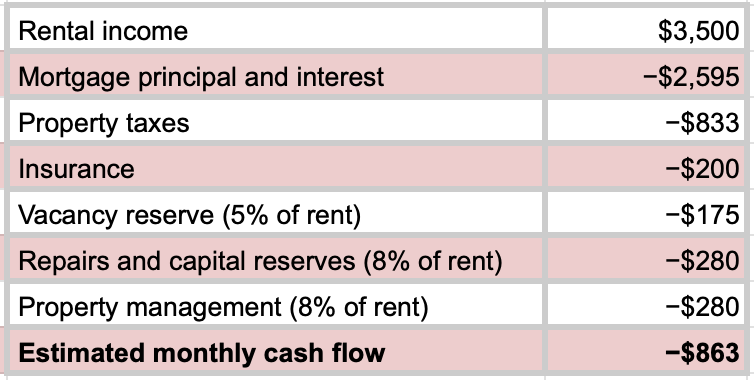
These figures are illustrative, not a representation of current rents, taxes, insurance quotes, or a specific available property. The mortgage estimate is rounded, and the calculation excludes initial closing costs, owner-paid utilities, HOA fees, and other potential expenses.
The result matters: this hypothetical property would lose about $863 per month before taxes and other omitted expenses.
That doesn't automatically mean the property is a bad investment. An investor might use a different financing structure, have higher verified rent, pay a lower purchase price, or use a long-term strategy that accounts for principal repayment and potential appreciation.
But it does mean the property wouldn't cover its expenses from rent under these assumptions.
That's precisely why you want to do the math before you buy.
5. Understand Cash Flow, Cash-on-Cash Return, and Appreciation
Three measures can help you evaluate an investment property.
Cash Flow
Cash flow is the money left over after rental income pays operating expenses and debt service.
Positive cash flow means the property generates money under the assumptions used. Negative cash flow means you need to contribute additional funds to cover the shortfall.
Cash-on-Cash Return
Cash-on-cash return compares annual pre-tax cash flow with the cash you invested upfront.
For example, if you invested $150,000 and the property generated $7,500 in annual pre-tax cash flow, the cash-on-cash return would be 5%.
That calculation should use your actual cash invested, including relevant acquisition costs and initial improvements, and clearly define which expenses are included.
Appreciation and principal repayment
A property's value may increase over time, and mortgage payments may reduce the outstanding loan balance. Both can contribute to long-term wealth.
However, appreciation isn't guaranteed, and equity isn't the same as cash you can use to pay bills. You may need to sell or refinance to access it, and both involve costs and risks.
A good investment analysis considers these potential benefits without relying on them to excuse unsustainable cash flow.
6. When Is the Best Time to Buy an Investment Property?
No single month or market condition guarantees a successful investment.
Instead, evaluate the opportunity across several factors.
The purchase price makes sense. The property's expected income and expenses justify the amount you're paying.
The financing works. You can handle the mortgage payment and other costs without depending on optimistic assumptions.
Evidence supports the rental demand. Comparable rental listings, local conditions, and the property's features support your projected rent.
You have adequate reserves. You can manage vacancies, repairs, and unexpected costs without jeopardizing your finances.
The investment fits your time horizon. You understand how long you plan to hold the property, what might prompt a sale, and what happens if your plans change.
A buyer who finds a property at a compelling price but cannot cover its expenses may be taking on a very different investment from someone who purchases a property with sustainable cash flow and adequate reserves.
Waiting for lower interest rates is not automatically the answer, either. Rates could fall, remain elevated, or move differently than expected. If lower rates attract more buyers and increase competition, the purchase price may change as well.
The better question is whether the deal works under realistic assumptions today—and how resilient it would be if those assumptions change.
7. Think About the Property's Location and Long-Term Appeal
Local knowledge matters because rental demand and operating costs can vary significantly from one community to another.
In Northern New Jersey, investors may want to evaluate proximity to train stations, major employment centers, downtown amenities, schools, and other features that appeal to their intended tenant.
But a desirable location alone doesn't guarantee a good return.
A property in a popular commuter town may command attractive rent while also carrying a high purchase price and property tax bill. Another property may cost less but require more maintenance or appeal to a narrower tenant pool.
Consider the full picture: expected income, ownership costs, potential resale demand, and the practical work of managing the property.
Before purchasing, also confirm applicable rental rules, local requirements, insurance coverage, and any restrictions imposed by an HOA or condominium association.
8. The Bottom Line: Buy the Numbers, Not Just the Story
Rental property can fit into a long-term investment strategy, but it isn't automatically profitable just because real estate has historically appreciated or because rent comes in every month.
The strongest starting point is a realistic financial analysis.
Know your upfront investment. Verify your expected rent. Include all meaningful expenses. Stress-test the deal against vacancies, repairs, and financing changes. Then decide whether the potential return justifies the required risk, effort, and capital.
And remember: a spreadsheet is only as good as its assumptions.
*For personalized investment, financing, and tax decisions, consult the appropriate financial, lending, legal, and tax professionals.